


Industry Partnership Takes Student from Classroom to Cancer Research
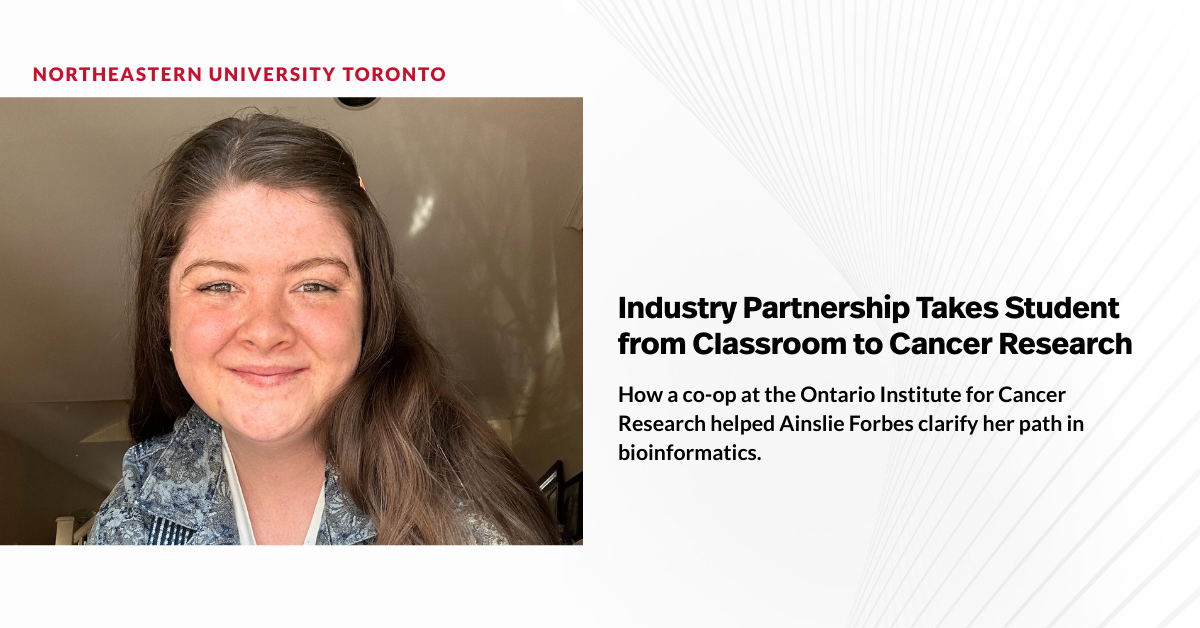
Ainslie Forbes recalls sitting in company-wide meetings during her co-op at the Ontario Institute for Cancer Research (OICR) and hearing patients’ stories. Much of her role was spent behind a computer, supporting the data that underpin cancer research in the province. But those meetings brought the human impact of her contributions into focus.
The co-op proved eye-opening for the Master of Science in Bioinformatics student. It not only exposed her to the realities of cancer research but also helped her determine her own professional goals.
“I wasn’t sure whether I wanted to continue to a PhD or go straight into the workforce after my master’s,” says Forbes, who is the first Northeastern University student in Toronto to complete a co-op at the OICR. “This co-op helped me see the kinds of roles available and decide that I want to enter the field now. It also showed me that you can do meaningful research with a master’s degree and still grow professionally.”
Choosing a career-focused graduate program
The clarity Forbes gained during her co-op began with the decisions she made during her Bachelor of Technology in Biotechnology. While she always knew she wanted to pursue a master’s degree, it wasn’t until she took a bioinformatics course that her career path emerged.
“I realized how much I liked the mix of biology and coding,” says Forbes. “That class showed me how I could combine both worlds.”
When choosing a graduate program, Northeastern University’s Toronto campus stood out. Forbes liked the idea of staying in Toronto while studying at a university with a strong reputation in the United States. Just as importantly, the Master of Science in Bioinformatics program aligned with her interest in academic training with a bridge to industry.
Once in the program, Forbes found Northeastern University’s experiential learning approach central to her development. Through real-world case studies, practical assignments, and working with real datasets, she began building the technical foundation she would rely on during her co-op. Specifically, coursework that emphasized workflows (step-by-step processes for analyzing large biological datasets), along with experience with high-performance computing systems, helped prepare her for the demands of an industry setting.
“Since the OICR is such a big organization, you’re not running one set of samples, you’re running multiple sets,” she says. “I was able to tackle that during my co-op with my foundation from class and by asking my manager a lot of questions.”
Experiential learning with impact
During her co-op at the OICR, Forbes worked in the Genetic Sequencing Informatics (GSI) department. Operating within a highly regulated research environment, Forbes contributed to maintaining and updating data analysis workflows, troubleshooting issues, and validating updates to meet strict provincial standards. The work plays a critical role in ensuring data can be reliably translated into clinical reports for hospitals.
The experience gave her exposure to the scale and precision required in large research organizations, and to how infrastructure supports science at every level.
“At school, you do a lot of individual projects, and at smaller companies it’s often the same,” Forbes says. “But at a huge organization like the OICR, you aren’t working on just one project. You’re working across multiple projects and on shared infrastructure. It’s incredible to see and learn all the processes that go along with that.”
The role of mentorship in the OICR co-op experience
Before applying to the position, however, Forbes wasn’t sure that a co-op fit into her plans. She credits faculty encouragement — particularly from Dr. Oyeronke Ayansola — with helping her see the value of gaining industry experience in a competitive field. With additional support from her co-op advisor, Forbes refined her résumé and prepared for the interview process, drawing on coursework such as poster presentations and workflow-based assignments to demonstrate her technical skills.
On the job, mentorship remained a significant part of her co-op experience. Forbes worked closely with Lawrence “Larry” Heisler, Senior Manager of GSI at the OICR, who guided her through unfamiliar processes, asked thoughtful questions, and encouraged her to attend internal talks.
“Larry is really good at acknowledging that co-op students won’t know everything, and that this is a huge learning experience,” says Forbes. “It’s so nice to have a manager who understands where you are and allows you to grow.”
For his part, Heisler notes that the OICR regularly hosts co-op students, assigning them meaningful project work that contributes to production operations while building their skills in cancer research and bioinformatics. As the first Northeastern University student to complete a co-op at the OICR, Forbes, Heisler says, has solidified the industry partnership and paved the way for other students.
“Ainslie has shown great initiative in moving her projects forward, and her work is expected to improve our analysis pipelines,” he says. “She has integrated well with the OICR and the GSI team, and hopefully, her time with us has contributed to the achievement of her career goals. We look forward to future opportunities to work with the Northeastern co-op program.
By: Izabela Shubair