


From Kinesiology to a Biotech Master’s: A Purposeful Pivot
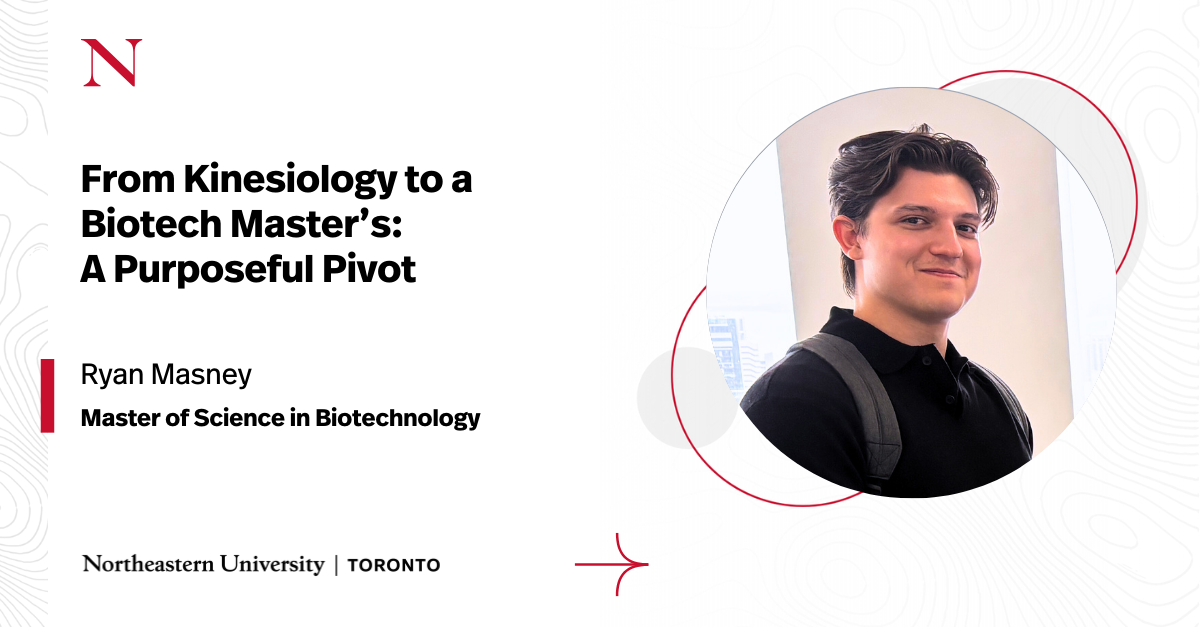
Ryan Masney once pictured a career in medicine. Over time, though, he realized he was more interested in the mechanics of science than its clinical practice. That insight steered him toward an undergraduate degree in kinesiology, where he started to see how the health sciences could intersect with emerging technologies. As he moved through the program, Masney found himself looking for a path that blended biology, innovation, and real-world problem-solving.
That’s when a bigger shift began to take shape: a move into biotechnology.
When he began exploring master’s programs in Toronto, Masney knew he wanted something anchored in practical application, industry-connected faculty, and a curriculum that opened global career pathways. His research led him to the Master of Science in Biotechnology program at Northeastern University in Toronto, where he enrolled just six months after completing his bachelor’s degree.
“I approached grad school with long-term thinking, and I was interested in working in the U.S. eventually,” says Masney. “Northeastern stood out because it would give me a globally recognized credential while letting me stay closer to home. Plus, the school focuses on real-world teaching, which you don’t always get in university.”
Faculty support in action
From the moment he stepped on campus, Masney noticed a difference — not just in Northeastern University’s experiential approach to learning, but how the learning felt more personal. Smaller class sizes created space for meaningful discussion, peer collaboration, and one-on-one time with professors. Expanded access to online research databases and academic resources further broadened his perspective. But what stood out most were the people behind the courses.
“In undergrad, I rarely talked to my professors, and I was one of 1,500 kids in a classroom,” he says. “At Northeastern, you’re able to build more of a personal relationship with professors, and they want to see you succeed.”
Masney says that how closely professors are involved in students’ career development is a valuable aspect of the program. In Dr. Dennis Fernandes’ classes, for example, experiential learning takes centre stage, with guest speakers joining discussions on AI and current market trends in drug discovery. Many professors also remain active industry practitioners, bringing real-time insights directly into the classroom.
That faculty support continues beyond the classroom, with Dr. Carol Hannam sharing networking opportunities and job openings through weekly newsletters. The active mentorship and insight helped lead Masney to one more major pivot.
“Dr. Carol will sit down with you and really try to understand what your goals are,” he says. “Then she grounds you in reality by pointing to current industry areas of growth. I came into the program wanting to work in research and development, but through exposure to different concepts in class and mentorship from my professors, I realized I’m more interested in the manufacturing and business development side of the industry.”
Why a biotechnology master’s with embedded experiential learning was the right fit
As he prepares for his academic-to-industry transition, Masney is also taking full advantage of the experiential learning opportunities built into Northeastern University’s biotechnology program.
While searching for a co-op opportunity, he is participating in an Experiential Learning project through his Special Topics in Biotechnology course. Embedded in select classes, experiential learning projects allow students to work on six-week engagements that inform real business decisions. Masney’s team is currently collaborating with a Vancouver-based startup to help design an AI-driven platform for creating new molecules.
“It’s a really cool experience because you’re working with people who are actually in the industry and applying what you’re learning to a real challenge,” he says.
In another course, Masney and his classmates were tasked with developing a novel biotechnology concept and pitching it to their professor. The project required the students to draw on their scientific training while also considering commercialization, regulatory pathways, and market viability. Masney says the experience has helped him learn how to raise ideas in the workplace.
“We’re gaining realistic skills for real jobs, including soft skills and presentation skills,” he says. “One of the things I love most about the program is that Northeastern focuses on professional development in a way I’ve never seen in academia.”
Masney is also experiencing the cross-border collaboration that initially drew him to Northeastern University. Through the university’s global campus network — which connects students across 13 locations worldwide — he has taken courses alongside peers in the U.S., participating in shared discussion boards and joint video lectures. The exposure has reinforced his interest in building a career that spans borders and sectors.
Looking ahead, Masney is open to where his path might lead next. While the U.S. remains a long-term goal, he’s equally interested in gaining experience in the Toronto biotech sector, with a growing focus on manufacturing and business development within the pharmaceutical industry.
“My life is all pivots,” he says, laughing. “I’m excited to get my foot in the door and see where my career goes.”
By: Izabela Shubair