


How One Information Systems Student Learned to See Beyond the Code
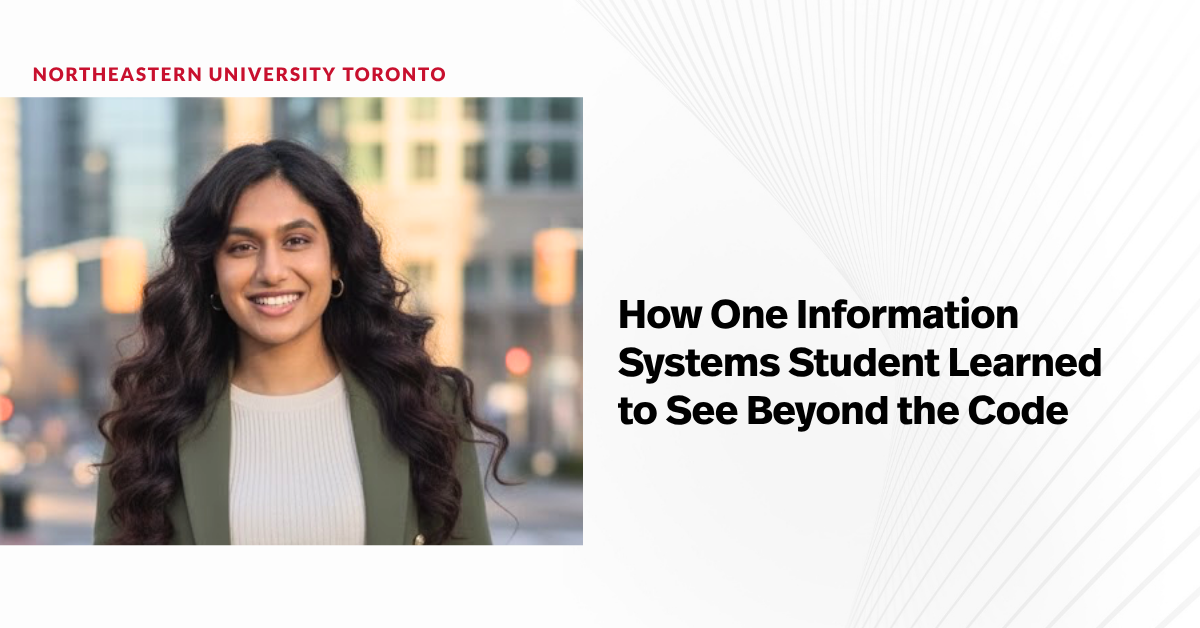
Vrinda Shinde entered Northeastern University in Toronto’s Master of Science in Information Systems program with a clear goal. She wanted to better understand the “why” behind complex system architectures — and to build technology that’s not only scalable, but secure and impactful.
“I had been writing code for a while, but I knew it was a small part of a much bigger system,” Vrinda says. “I became more and more interested in systems thinking and understanding how technical decisions impact business. That’s what attracted me to Northeastern University’s program.”
From electronics to systems thinking
Although Vrinda earned her Bachelor of Engineering in Electronics and Telecommunication in her native India, her internships and early professional experiences quickly shifted toward software development. Over time, that focus became a clear career direction: building scalable software systems. While she strengthened her practical skills as a Java full-stack developer, Vrinda says she realized she needed to formalize her training to ensure a stronger foundation and broaden her perspective.
“When I found myself working on the software side a lot during my degree and internship,” she says, “I realized I enjoyed doing that much more than hardware. It inspired me to take the next step and pursue my master’s.”
At Northeastern University’s Toronto campus, that interest began to take shape in a program designed to bridge business needs with technical implementation, with opportunities to apply that learning through co-op experiences. Courses in software engineering, data science, and AI pushed Vrinda beyond coding alone and into systems thinking and research-driven exploration. Faculty, including Dr. Zheng Zheng and Dr. Omar Badreldin, helped strengthen her technical foundations and mastery of system design.
One course that stood out was Dr. Junwei Huang’s Data Science Engineering Methods, where students were encouraged to build projects rooted in real-world challenges. Vrinda applied that approach to a familiar frustration: delays on the Toronto Transit Commission (TTC) subway system. She developed a machine learning model to predict how long disruptions may last.
“Professor Huang really inspired me to create something everyone in Toronto could use,” she says. “When there’s a delay on the TTC, you don’t know if you’ll be stuck for five minutes or 30 minutes, so this will help people determine if they should wait or find another way to their destination.”
Real-world learning in action
A defining moment came during Vrinda’s eight-month co-op at RBC, one of several offers she received. Though she had initially applied for a full-stack developer role, she accepted a cloud security developer intern position, eager to dive into new tools and environments.
“Amazon Web Services (AWS) cloud security was completely new to me because I hadn’t yet taken my cloud classes, so the first month was a bit overwhelming,” she says. “But Professor Zhang had really encouraged us to practice our data structure skills and problem-solving. So, even though I was familiar with Java and had to switch to Python for my co-op, I relied on the idea that the underlying logic of software development is the same, no matter the language.”
Drawing on her background and what she had learned in her master’s program, Vrinda worked in the development, security, and operations space, focusing on cloud governance. In her role, she developed compliance checks in AWS to ensure cloud services operated securely and consistently across multiple services and contributed to a more flexible policy-compliance framework.
Vrinda also brought that experience into RBC’s internal Quest Case Competition, where her team placed in the top three. Their three-part AI-driven solution addressed inefficiencies for more than 5,000 advisors. It combined real-time client support, smarter internal search, and automated documentation updates to reduce handling time and improve accuracy.
“It was rewarding to work on a problem that needed a human touch while still using AI,” Vrinda says. “We focused on making customer service calls more efficient for advisors, while also giving teams AI tools that made their work easier.”
Alongside her co-op, Vrinda continued to reinforce her learning through projects. During a Software Engineering course, she worked on collaborative simulations of real-world development cycles, emphasizing scalable architecture and team coordination. She also tackled autonomous, self-improving systems, navigating challenges like model convergence and experimental uncertainty while developing a structured, resilient approach to problem-solving.
A broader perspective on technology
With graduation approaching this spring, Vrinda says the MS in Information Systems has reshaped how she approaches technology — shifting her focus from writing code to thinking more broadly about systems, collaboration, societal impact, and long-term sustainability. She’s now looking to build a career as an AI software engineer, applying the same curiosity that first drew her to the program.
“Northeastern helped me build confidence in many ways, especially in the systems thinking I came here for,” she says. “Instead of just focusing on the end result, I think about how a solution connects to other systems, how it scales, and how it impacts the bigger picture. Now, I want to work at the intersection of AI and software systems to help improve business outcomes.”