


Shaping Hands-On Project Management Education
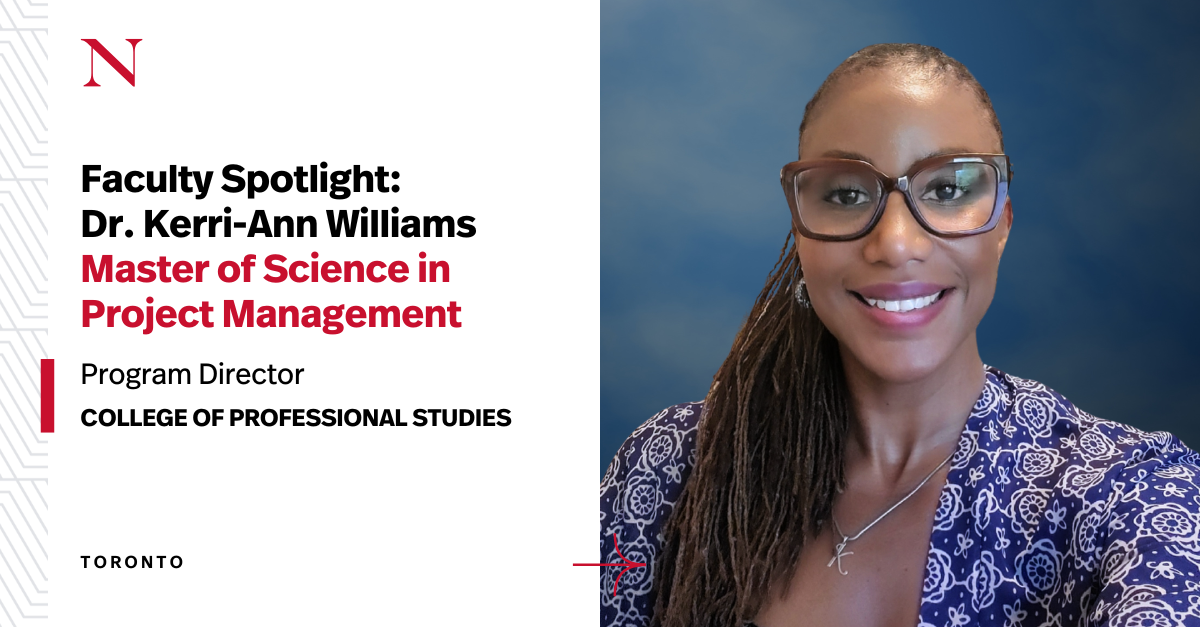
Whether she was working in military operations, private security management, food processing, quality management systems, or, most recently, healthcare technology, Dr. Kerri-Ann Williams consistently found herself in project management (PM) roles.
Now, as an assistant teaching professor at Northeastern University, she brings her 15 years of diverse industry experience into the classrooms of the Master of Science in Project Management program.
This summer, Williams will expand her impact to all of Northeastern University’s North American campuses. She will continue teaching while also taking on a new position as program director for MS in Project Management offerings in Canada and the U.S., which are accredited by the Project Management Institute’s Global Accreditation Center, the world’s leading association for project management professionals. This globally recognized accreditation assures students and employers of the program’s quality, relevance, and career value.
“Project management kept following me across roles and industries,” says Williams, who formalized her training with a Doctor of Business Administration, focusing on project management in 2021, and also holds a Bachelor of Science in Biotechnology, an Advanced Diploma in Biomedical Engineering Technology, and a Master of Business Administration, specializing in healthcare management.
“The beauty of being a PM is you don’t have to be an expert in any one thing. You have the technocrats for that. I always think of myself as an invisible hand that puts all the pieces in place, allowing experts to focus on what they do best. That’s what I try to instill in my students.”
PM Education Meets the Real-World Application
Williams’ industry career provides a rich foundation for her teaching and deeply informs her approach.
Before joining Northeastern University in Toronto, she served as the Director of Projects and Research at Highmark Interactive, a digital health organization specializing in cognitive wellness. The company pioneered a hybrid approach to providing specialty clinical services for cognitive health and neurological conditions.
In this position, Williams oversaw medical software development and integration projects within large healthcare systems.
“This was an exciting role,” she says. “One of the most interesting projects was looking at cognitive roadside assessment for detecting cannabis impairment, which was a hot topic at the time. I also had the opportunity to grow with the company from a Project Manager in clinical research to Director of Projects and Research.”
In 2021, Williams began combining her industry experience with academia by accepting teaching stints, where she led courses in project management and health systems management. Through these opportunities, she discovered a strong passion for education, which inspired her to pursue a full-time academic career.
“Especially at the graduate level, I very much encourage my students to approach their courses not as a box to check off but as an exercise in knowledge and skill set development,” she says. “As someone who originates from industry, I emphasize practical application. Theory is important as a foundation, but if you can’t apply it to a real-world setting, it is not valuable.”
Rather than following a traditional lecture format, Williams’ classes revolve around practical application, like case studies. She often pre-records her lectures so that students can listen to them beforehand and use the class time to apply their knowledge.
For example, a segment she calls “Projects in the News” involves students critically assessing projects that are making headlines. For example, earlier this year, Williams tasked her Project Scheduling and Cost Planning class with critiquing the proposed schedule and budget for Alto — the high-speed rail network planned for the Toronto-Quebec City corridor. Students used estimation techniques they covered in class.
Williams says that approach aligns well with Northeastern University’s experiential learning ethos and has been overwhelmingly positive.
“The classes are always interactive,” says Williams. “Students appreciate that they are mastering the material through critical thinking and developing their skill sets by engaging with the content more actively.”
Applying Her Knowledge as Program Director
In July, Williams will become the program director for Northeastern University’s MS in Project Management programs across North America. She will be responsible for ensuring the program remains relevant in today’s changing market and maintains a strong connection to the industry. Currently, Northeastern University’s global alum network, for example, includes project managers across a range of sectors from prominent companies such as IBM, Biogen, National Grid, and Procter & Gamble.
“My job as program director is to ensure that when our students graduate, the industry will value their diploma and that it will reflect a high level of competence,” she says. “At the heart of that is our faculty, many of whom are still connected to industry. Ensuring that we have practitioners who can bring their experience into the classroom and expose students to best practices as well as their professional networks is key for me.”
For the Toronto campus offering in particular, Williams says she also views the role as an opportunity to uphold Northeastern University’s reputation as a respected leader in project management, while further integrating the program within the Greater Toronto Area.
“The program is excellent,” she says. “I’m excited to stand on the shoulders of those who went before and see what we can achieve in terms of growth in regional reputation. It’s also important to note that this is a collaborative effort, and everyone in the College of Professional Studies is eager to contribute.”
By: Izabela Shubair