Biotechnology Graduate Builds Career in Finance
May 21, 2026
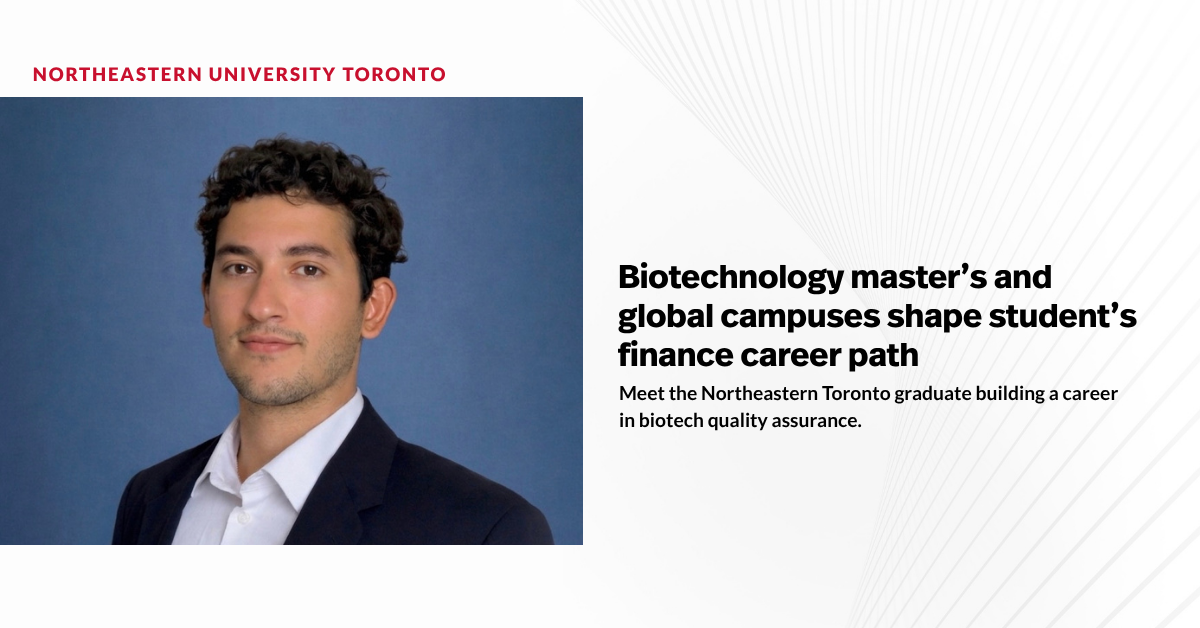
Sasha Arbid remembers long nights combing through medical journals — not for an assignment, but for answers.
As a pre-med undergraduate student, he developed a severe autoimmune condition triggered by COVID-19. Doctors told him there was no cure. Arbid refused to accept that.
While continuing his studies and working at University Health Network, he began reviewing clinical literature and experimental treatments. His search led to an Eli Lilly and Company-developed drug. After years of persistence, including convincing a physician to try the drug for his condition, Arbid began treatment. Sixteen months later, he had fully recovered.
The experience changed everything. It not only eventually led him to contribute to the Canadian launch of the drug that cured him, but also to the Master of Science in Biotechnology at Northeastern University in Toronto.
Having graduated in 2025, Arbid is now pursuing the MS in Qualitative Finance/MBA dual degree at Northeastern University in Boston — building on a multi-campus graduate journey that bridges science and finance into ambitious career outcomes.
“One of the main advantages of Northeastern University is its big network of satellite campuses, which very few schools have,” Arbid says. “It gives you access to study options and opportunities because the brand is very recognizable, especially in the U.S.”
Experiential learning approach to a biotechnology master’s
At Northeastern University in Toronto, Arbid found a campus that gave him closer access to faculty and numerous ways for experiential learning. In environments optimized for practical experiences and collaboration, he dove into gaining a deeper understanding of biotechnology.
“Everyone was working with each other, and everyone was willing to help with the next steps,” he says. “Dr. Carol Hannam would help me strategize and send me companies on LinkedIn to reach out to for opportunities. She also wrote me a reference letter when I applied for my MBA. Not a lot of professors go out of their way like that.”
That same environment also created opportunities to apply his learning in professional settings. Through an embedded capstone project, Arbid worked with a company partner to solve a business challenge. He and his team collaborated with a startup using DNA test results to recommend mental health drug dosages. Noting a similar product already on the market, they advised the company to instead focus on oncology.
“The capstone was one of my most enriching experiences,” he says. “Developing that recommendation was more applicable than a school lecture. In job interviews, you want to be able to speak about the practical things you’ve done, and the capstone gives you that.”
Leveraging professional master’s pathways
As he progressed through the master’s in biotechnology, Arbid began to develop an interest in capital markets and finance, exploring how the two fields intersect. A “shot in the wind” email to the head of healthcare investment banking at RBC led to a meeting and invaluable advice that helped him secure an internship at a boutique investment banking firm and ultimately decide to pursue an MBA. That’s when Northeastern University’s Global Campus Network became a professional master’s pathway asset.
“In my last semester, I was able to take finance electives online that were offered in Boston,” Arbid says. “It made the transition easier when I entered the MBA, and some of those courses may even be able to count as credits.”
Now in the midst of his MBA, Arbid is preparing for the next part of his journey. This summer, he’ll join Goldman Sachs in New York as an MBA equity research associate focused on biotechnology and pharmaceuticals.
“Goldman Sachs is one of the best financial institutions for training,” he says. “I’m looking forward to absorbing as much as I can, meeting as many people as I can, and blending biotech and finance at a high level.”
By: Izabela Shubair