From Regulatory Affairs Education to Mentorship and Impact
March 13, 2026
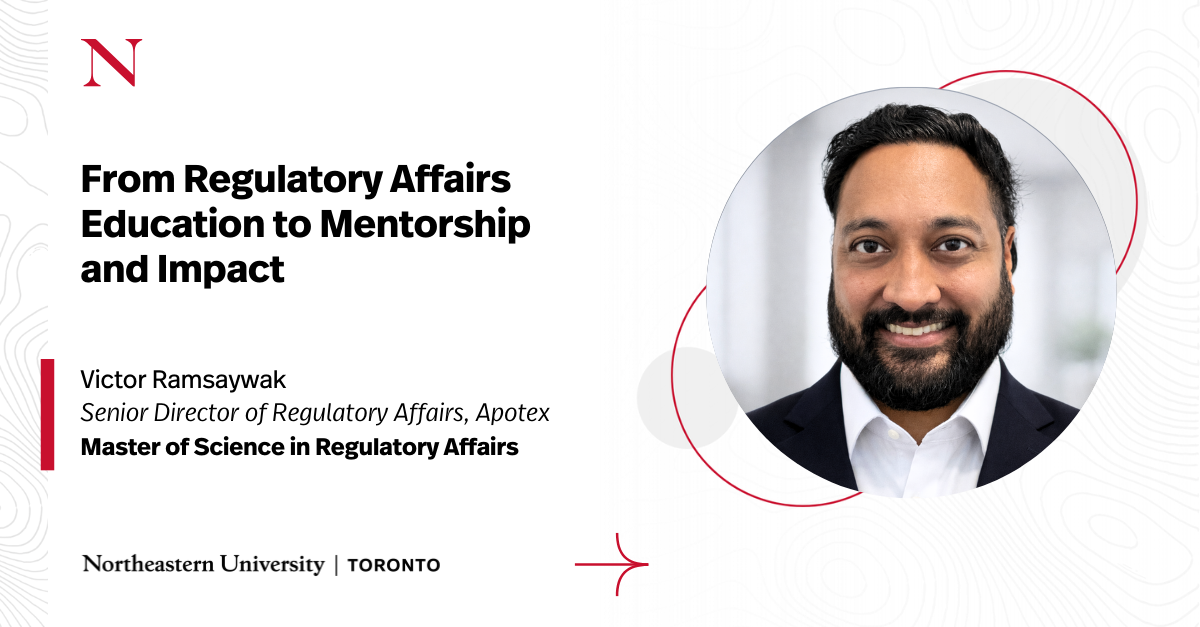
As a high school student, Victor Ramsaywak got his first glimpse of the pharmaceutical industry while working in production and packaging. He secured the role at Apotex Inc., Canada’s largest manufacturer of generic medicines, through a program that offered employees’ children the opportunity to apply. The experience was formative. It helped Ramsaywak discover that his interest in life sciences lay in industry rather than in medicine.
More than 25 years and many career advancements later, Ramsaywak is now Apotex’s Senior Director of Regulatory Affairs. Today, he is focused on providing graduate students with exposure to the field and professional mentorship — the same kind of access that helped shape his path.
That mindset was reinforced during his time as a Master of Science in Regulatory Affairs student at Northeastern University in Toronto.
“Something I noticed when I was at Northeastern was that the professors had a genuine interest in teaching students and sharing real-world knowledge,” says Ramsaywak, who graduated in 2021. “It’s about passing on what you know, emphasizing the importance of continuous learning, and ultimately, hopefully helping to set someone up to do well in their career.”
New Perspectives Through Regulatory Affairs Education
Ramsaywak has long viewed learning as a way to step outside his comfort zone and routine. One of the first graduates of the Regulatory Affairs master’s program at the Toronto campus, Ramsaywak had already earned a Bachelor of Science in Biology and a Master of Business Administration before enrolling. By that point, he had also spent years navigating increasingly complex cross-functional teams in supervisory and managerial roles.
As his responsibilities grew, returning to the classroom, Ramsaywak says, was a way to sharpen his thinking and broaden his perspective.
“If you become too focused on your day-to-day job, you can fall into a routine and become complacent,” he says. “By learning something new, you challenge yourself and rewire your brain to think differently, whether that’s more strategically or from a fresh outlook. That was really the biggest takeaway for me, besides the updated knowledge.”
While completing the program, Ramsaywak, who was already in his role at Apotex during his studies, expanded his expertise beyond his immediate professional focus. Exposure to areas such as biologics and medical devices encouraged him to take a broader approach to regulatory problem-solving, offering insights he could apply directly to his work.
“It’s really beneficial to get knowledge outside your niche,” he says. “It strengthens how you approach your work. I think people also take for granted that a master’s-level program makes you a better writer. In a field like regulatory affairs, it’s a key skill because the work requires clear, precise communication.”
Giving Back to Future Regulatory Affairs Professionals in Toronto
Despite completing the program remotely during the COVID-19 pandemic, Ramsaywak says experiential learning, a staple of Northeastern University’s approach, still played a meaningful role in his education.
His capstone project focused on developing a generic drug risk-minimization program. It’s an exercise he describes as fully immersive and closely aligned with actual regulatory challenges. While the program’s structure has since evolved with the addition of embedded Experiential Projects in specific courses, the intent remains the same.
“Our capstone course was 100% realistic, which I appreciated,” he says. “Now students have other experiential learning opportunities, but the goal is still to give them a chance to get their feet wet in the field.”
The emphasis on applied learning stayed with him after graduation. As Ramsaywak’s career advances, so does his interest in helping students translate theory into practice — particularly through experiences that mirror the realities of regulatory work.
That commitment has led him back to Northeastern University in Toronto, where he supports students as a member of the Regulatory Affairs Program Advisory Committee and by taking on students for both capstones and Experiential Projects.
“I’ve been in the industry for 25-plus years, and I’ve seen how valuable it is to bring new ways of thinking into the field,” he says. “Northeastern students come in with strong research skills and the latest in AI knowledge. I’ve always believed in immersing students in the experience right away, and they are always up for it and eager to try new things in professional settings and diverse situations.”
Ready For What’s Next
Ramsaywak’s path has come full circle in many ways, but he’s quick to point out that it hasn’t reached an endpoint. As he helps guide regulatory affairs professionals in Toronto entering the field, he’s also stepping into new challenges of his own. Ramsaywak’s manager recently nominated him to lead Apotex’s artificial intelligence efforts in the company’s Global Regulatory and Medical Affairs department.
The unexpected turn underscores how quickly the regulatory landscape continues to change—and why ongoing learning remains essential.
“For me, it’s not about coming full circle, but about staying open, just as I did by continuing my education,” he says. “My role may not end up where I expected it to, and I’m ready for whatever comes next.”
By: Izabela Shubair